
How scoring works
The formula in full, and what it is quietly training you to do.
Prepare's score is a rating computed from your last hundred ranked attempts, not a total you accumulate. It can go down.
What one attempt records
Every answer you give in the route choice game writes one row: whether you were right, how long you took in milliseconds, which route you picked, which one was correct, how many routes were on screen, and whether the attempt counts toward the global leaderboard.
Correct means shortest. The answer is the route with the smallest measured length, taken from the lengths stored with the map. The main flag in the map file is a drawing-order label and does not indicate which route is shortest.
The first three challenges in a session are a warm-up. They show whether you were right and are not recorded.
The formula
score = (1000 ÷ speed) × accuracyMultiplier × 100 × recency
speed is your weighted mean response time in milliseconds, over correct attempts only; recency is explained below
The two inputs are not symmetrical. Speed enters linearly: halving your response time doubles the base. Accuracy enters through an exponential multiplier, which spans more than an order of magnitude.
The accuracy multiplier
multiplier = e^((accuracy − 50) × 0.035)
k = 0.035; accuracy is a percentage from 0 to 100
Fifty per cent gives a multiplier of exactly 1, which is what guessing returns on a two-route challenge. Above it the multiplier rises exponentially, and below it falls the same way.
| Accuracy | Multiplier | What it means |
|---|---|---|
| 100 % | 5.75× | Every ranked answer right |
| 90 % | 4.06× | Strong: one mistake in ten |
| 75 % | 2.40× | Solid; roughly the ceiling of intuition on hard legs |
| 60 % | 1.42× | Better than guessing, but not by much |
| 50 % | 1.00× | Baseline: a coin flip on two routes |
| 25 % | 0.42× | Systematically wrong: you are reading something backwards |
| 0 % | 0.17× | Floor |
Below 50 %
A worked example
Two runners, same number of attempts. One answers in 1.4 s at 72 % accuracy; the other answers in 0.9 s at 58 %.
Runner A   1400 ms, 72 %
  base       1000 / 1400            = 0.714
  multiplier e^((72 - 50) * 0.035)  = 2.16
  score      0.714 * 2.16 * 100     = 154.3

Runner B    900 ms, 58 %
  base       1000 / 900             = 1.111
  multiplier e^((58 - 50) * 0.035)  = 1.32
  score      1.111 * 1.32 * 100     = 147.0
Runner B answers 36 % faster and still scores lower.
The rolling window
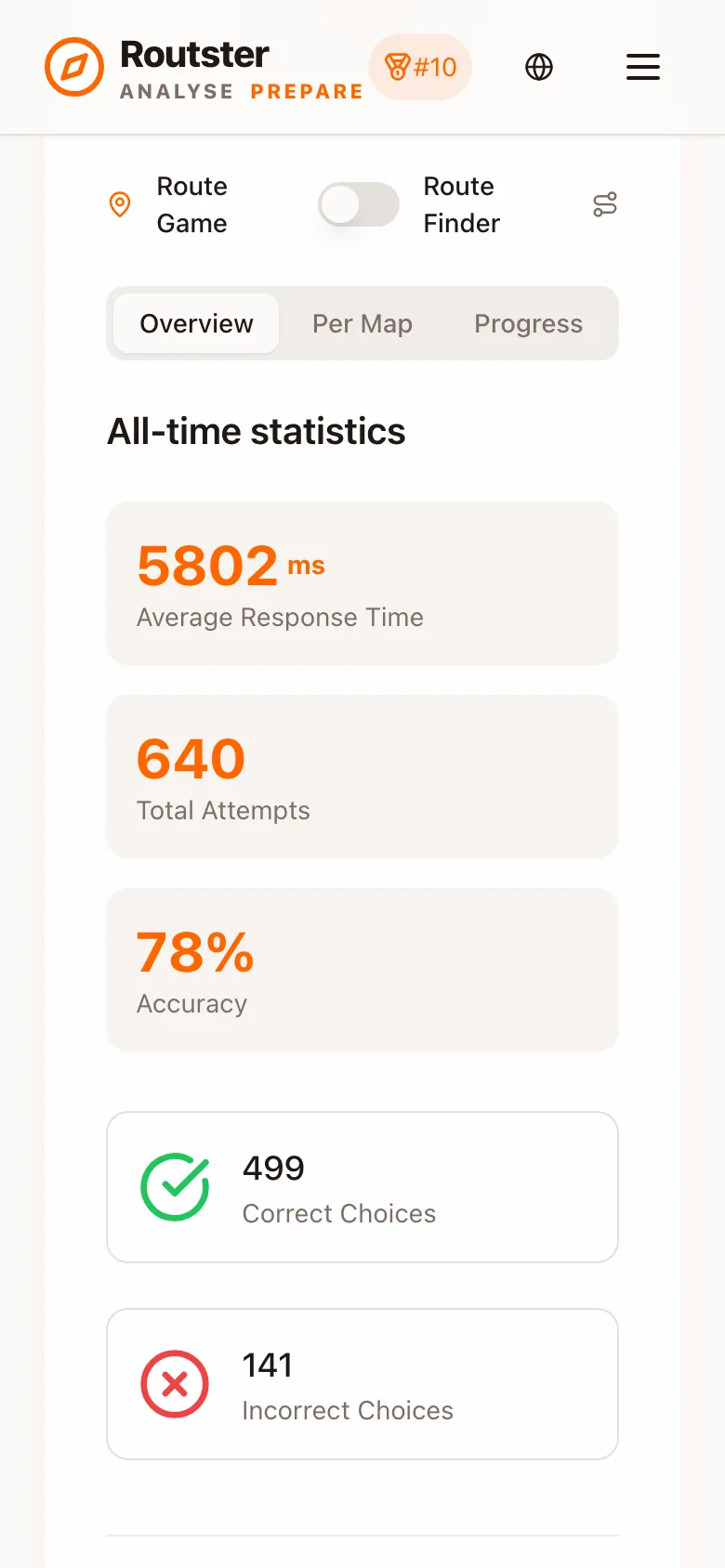
The rating is computed from your 100 most recent ranked attempts: the most recent hundred, not the best hundred. All-time totals are kept separately and shown on your profile; they do not affect your rank.
A bad session pushes older, better attempts out of the window, so the rating describes recent form.
Time decay inside the window
Within those hundred attempts, each one carries a weight based on its age:
| Age of the attempt | Weight | Effect |
|---|---|---|
| 0 to 30 days | 1.00 | Full value |
| 30 to 120 days | 1.00 → 0.00 | Linear fade over 90 days |
| 120 days or older | 0.00 | Counts for nothing |
Accuracy is the decay-weighted share of correct attempts; speed is the decay-weighted mean response time over the correct ones. Both are computed from the same rows.
A rating decays rather than freezing
Speed is measured on correct answers only
A wrong answer costs accuracy, and its response time is discarded. Answering instantly when unsure therefore cannot lower your average response time; it only lowers your accuracy.
Which attempts are ranked
An attempt counts toward the global leaderboard only when all four of these hold:
| Condition | Why |
|---|---|
| Official maps, not your own or community uploads | Everyone is scored on the same set of challenges |
| “All maps” selected, not one map | Practising one map you know well is training, not a comparable score |
| Multi-select off | Same reason: a hand-picked subset is not the common pool |
| Filters at their defaults, including 100 % route length | Filtering to the shortest, easiest legs would inflate accuracy |
Anything else still plays, still reports whether you were right, and still adds to your all-time totals, but does not move your rank. While they are off, the game says Unranked above the challenge, and the i beside it explains why.
Reading the leaderboard
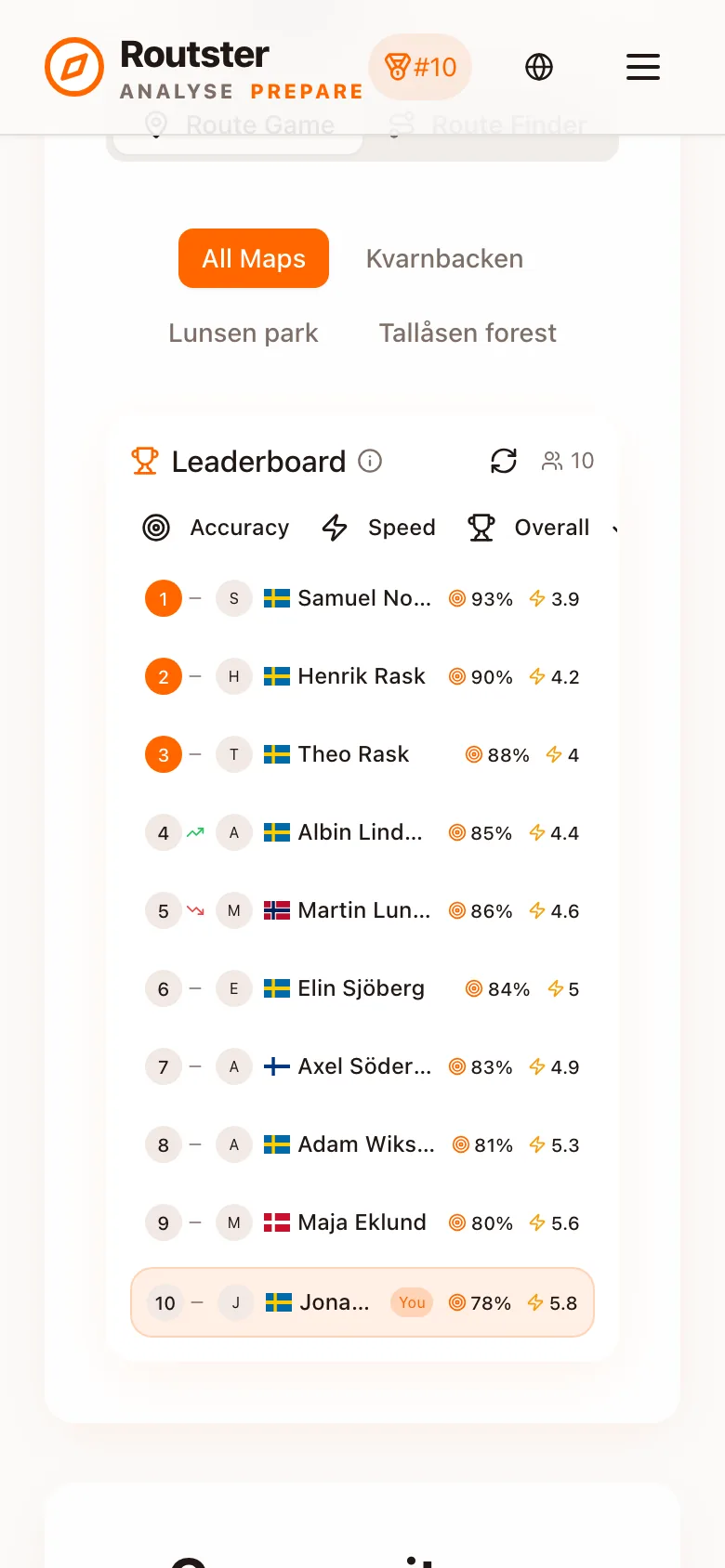
The leaderboard sorts by combined score by default, and can be re-sorted by accuracy alone or speed alone. There is also a country filter. The single-axis sorts show which half of your score is the weaker one.
Rank-change arrows appear only on the combined sort; accuracy and speed have no stored historical rank to compare against.
What this is training
The two axes are multiplied rather than added because in a sprint they are not independent: time spent deciding at a junction is time not spent running, and a slow decision can cost more than the route it saves.
What follows from the shape of the formula:
- Accuracy moves the score further than speed. Going from 65 % to 80 % multiplies the score by about 1.7×; matching that on speed alone would mean cutting your response time by roughly 40 %.
- The clock runs until you answer. A leg you find yourself re-measuring is one to revisit in Analysis mode afterwards.
- Analysis mode holds the map so you can zoom in and find the feature you misread, such as a fence, a passage or a set of steps.
- Decay and the rolling window both reward regularity.Twenty attempts every other day hold a rating that two hundred once a month does not.
Compare your two-route and four-route accuracy
The other modes score differently
The formula on this page is the route choice game's. The other modes have their own:
- Route Finder scores a drawing by its length against the optimal path, with penalties for missing the endpoints or cutting through impassable terrain.
- Route Navigator scores how much longer your walked route is than the shortest one, from 0 to 100, with 70 as a pass. Time is shown but does not enter the score.
- Duel scores per round, live against an opponent: 100 points for a correct answer plus a speed bonus of up to 50 relative to the other correct answers in that round.